Karachi Style vs Hong Kong Mahjong: Why I Stopped Chasing Authenticity
Have you ever dived into a game only to discover it’s not quite what you expected? For some, mahjong was absorbed through osmosis, watching mothers and aunties play across generations. For the rest of us, the entry point was more accidental. Mine came through a movie.
How I Started Learning Mahjong: From Zero to Karachi Style
A few years ago, while watching the famous mahjong scene in Crazy Rich Asians, a buried childhood memory surfaced: my neighbors in SIngapore, hunched over a table just outside their apartment door, playing with tiles that made the most mesmerizing clicking clacking sounds. I filed it away thinking one day I’ll have to learn , without any idea where or how.
Fast forward to November 2024, I jumped at the first real opportunity: a Facebook post asking who could teach Mahjong and the name “Mumtaz Aunty” popping up. Unlike Karachi’s Parsi community, who absorbed the game watching their mothers play, the rest of us had no such guide. Our mothers didn’t play or if they did, we weren’t paying attention. So I signed up for the weekly lessons with Mumtaz Aunty aka Monty to her friends and to us students as the Dragon Lady. 😄
It was a deep-end dive: two hours weekly, relying entirely on our memory to retain whatever was being taught. The nerd in me wanted to prepare betwen classes, but the books I bought and every online tutorial I found described a somewhat different game from what Mumtaz Aunty was teaching us. That’s when I realized we were learning a variant that had been played since the 1970s by a small, close-knit group of women in Karachi. Adapted over decades for fun, tile availability, and local preferences, their way of playing had no rule-book, just word-of-mouth, passed hand to hand across tables.
Discovering Thompson and Maloney: The Mahjong Book That (Partially) Helped
Five weeks into my classes, I was still thoroughly confused when visitors from Hong Kong and Dubai mentioned The Mah Jong Player’s Companion by Patricia A. Thompson and Betty Maloney. This book had been their bible for special hands when they were learning, so we tracked a down a copy.
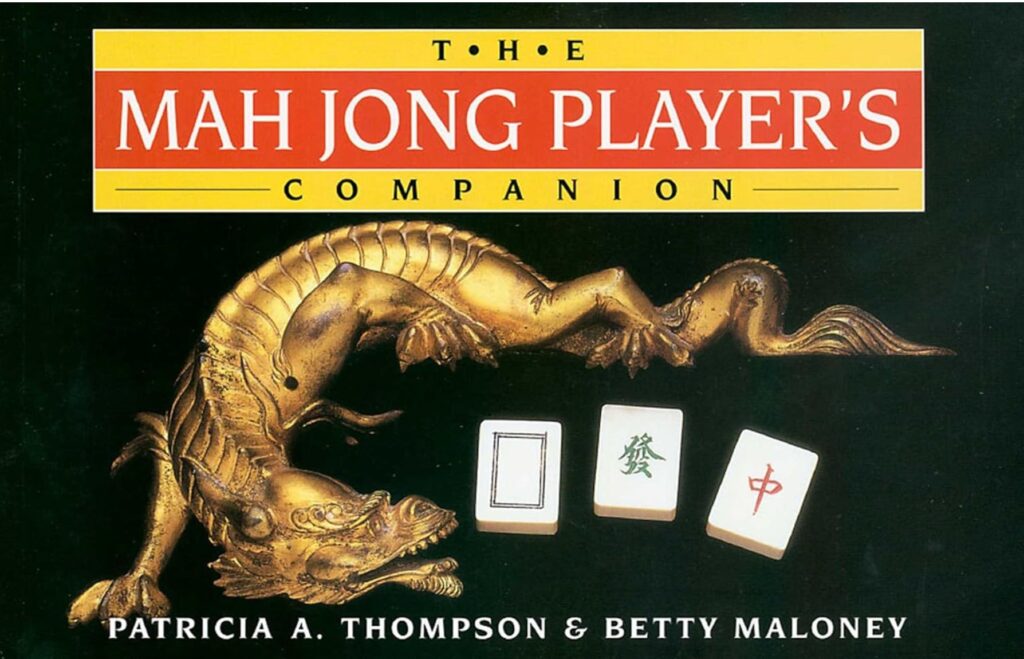
It only partially overlapped with Mumtaz Aunty’s teachings. She didn’t follow it strictly; and the similarities seemed hand-picked. I later realized why: THE BOOK was compiled for Western players who didn’t want the complexity of calculating scores from scratch. It offered a simplified structure with special hands and fixed scores, making the game accessible to new comers without a Chinese mahjong background.
Fascinated, I started blending it into games played outside class: using the Thompson and Maloney book for special hand, and adding Chinese-style “chow” moves, i.e taking tile discarded by the player on my left to complete a sequence of three – something strictly prohibited in Karachi Style. For scoring, we adopted the book’s simple system: Hands labeled Limit at 1,000 points, Half-Limit at 500.
It was fun, but I craved something more “authentic”, not this cobbled-together, improvised “jugaar” approach.
Quick note: In mahjong, a ‘chow’ is a move where you claim a tile discarded by the player to your left to complete a three-tile sequence in your hand. Karachi Style doesn’t allow it, which, as it turns out, is part of what makes the game so strategically distinct.
Chasing Authenticity: My Dive into Hong Kong Mahjong Rules
“Authentic” to me meant the way the Chinese played. I started exploring Hong Kong New Style mahjong, which had the most online tutorials, the widest global playing base and and a clear scoring system called with “faans”. Initially, it thrilled me: written rules covered in several books, a point system that was linked to how “featured” your hand was, and logical decisions. I felt like I’d unlocked the true game. But then, boredom crept in.
Why Hong Kong Style Started Feeling Too Narrow?
Hong Kong mahjong is built for speed. Small hands win, large ones are risky and statistically inefficient. The game rewards finishing fast and cutting losses. A philosophy, I suspect, that is deeply tied to its gambling roots, where quick turnover matters.
Over time, every session collapsed into the same rhythm: finish fast, minimize risk, skip anything complex. Hong Kong style builds strong fundamentals, and knowing it means you can sit down at a table anywhere in the world. But once I understood the system, the game lost its charm. My tiles never had a chance to build into anything. Every hand felt like a calculation, not a story.
Furthermore, convincing friends who played Karachi Style to try Hong Kong rules was also an uphill battle. It became abundantly clear that not everyone shared my enthusiasm to experiment across styles.
The Eureka Moment” What Karachi Style Mahjong is Actually Brilliant?
Here’s where the story turns.
While I was busy experimenting with other styles, I was simultaneously working on something much closer to home: documenting Karachi Style rules as a birthday surprise for Mumtaz Aunty. In the process of systematically picking her brain, asking why each rule existed, not just what it was, something clicked.
There was a coherent, elegant scoring logic underneath it all. We had been playing it for months without seeing it, because we’d never asked the right questions. Once it surfaced, Karachi Style stopped looking like a local hack of a Chinese game and started looking like a genuinely considered variant with its own internal logic.
Here’s what sets it apart: Karachi Style is structured around Wind rounds, and each round demands a completely different strategy.
• East Round: Honor-heavy hands only. Tiles like dragons and wind tiles must feature prominently
• South Round: No honors allowed. A complete reversal requiring you to abandon the previous rounds approach.
• West Round: Opens with a three-tile exchange followed by an all pung hand in the same suit. (a pung is three identical tiles. This rule means every meld/set in your head must be a triplet, not a sequence)
• North Round: The payoff round with massive, high-value hands, where patience and boldness are rewarded.
Each round forces a strategic reset. You can’t coast on one tactic across the game, even if you wanted to. The cautious player must eventually takes risks. Tables can easily turn on early leaders. Scoring is standardized across rounds, so a strong finish always matters. Unlike Hong Kong mahjong’s efficiency-first approach, Karachi Style rewards reading your opponents, pivoting boldly, and building hands that feel like they mean something.
The winds feel like triumphs, not just correct decisions. That’s a difference.
Why Hong Kong Mahjong Still Matters (And a Peek at Taiwanese)
Don’t get me wrong. None of this is a dismissal of Hong Kong style of play. It is foundational and considered the building blocks of Chinese mahjong. It has the usefulness that you can play it globally and it builds tile intuition you need for any variant. Think of it as the grammar before the literature.
And then there is Taiwanese Mahjong with its 17-tile hands and emphasizing gradual hand development over quick wins. I haven’t done a deep dive into it yet but it feels like a natural bridge between Hong Kong precision and Karachi’s flair for the dramatic. More on that when I get there.
The Karachi Style Mahjong Rulebook – Coming Soon
The birthday surprise for Mumtaz Aunty became something bigger.
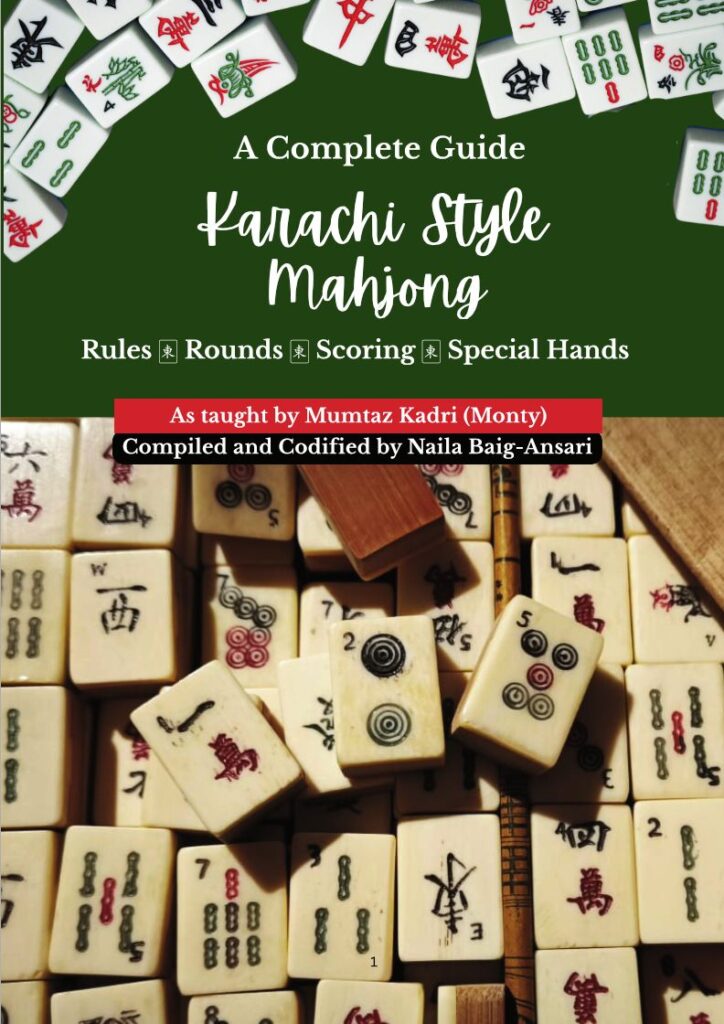
What started as a personal tribute to her 50 years of playing this game, entirely through word of mouth, has turned into the first complete written guide to Karachi Style Mahjong. It covers detailed rules for every Wind round, the scoring system we nearly missed, special hands, and strategy notes for players at every level.
It’s a way of honoring everything Mumtaz Aunty and her friends have built, and making sure this variant doesn’t fade away with time.
Pricing and details are still being finalized. However, if you want to be notified when it’s available, join the interest list here. Whether you’re a beginner or a seasoned player, it’s the perfect way to celebrate the jugaar spirit!
Which style of mahjong do you play and who taught you? Share in the comments!